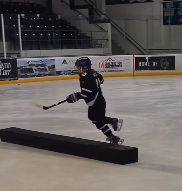
In modern hockey skill sessions, you occasionally see coaches placing hurdles on the ice. To the casual observer, it may look like a gimmick. But bounding is a sophisticated method of developing “active” skaters who possess superior edge control, explosive power, and injury resilience.
1. Mastering Edge Precision and Landing Mechanics
Unlike jumping on dry land, where friction and stable ground provide a safety net, jumping on ice is an unforgiving test of alignment. When a young player clears an obstacle on skates, the Landing Phase becomes the primary teacher.
To “stick” a landing on a 3mm blade, the player’s center of gravity must be perfectly centered over their mid-foot. This forces the neuromuscular system to calibrate the ankle’s medial and lateral stabilizers instantly. If the blade is even slightly tilted upon impact, the player will “wash out.” This discipline translates directly to high-speed cornering and puck protection.
2. Enhancing Stride Frequency through Active Recovery
One of the most common mechanical flaws in youth skaters is the “lazy recovery”—a slow, sweeping return of the foot after a stride. Obstacles solve this by introducing an immediate physical consequence.
The Neurological Shift: By forcing the player to “tuck” their feet to clear an object, we train the brain to prioritize a fast recovery. On the ice, this manifests as a higher stride frequency. The time spent in the air is minimized, and the foot is returned to the ice in a “loaded” position, ready for the next explosive push.
3. Reinforcing Low Centre of Gravity
Hockey is played in a deep knee bend, yet many players tend to stand taller as they fatigue. Jumping requires a Deep Eccentric Load (the dip) to generate vertical lift.
On-ice hurdles serve as a constant reminder of this athletic base. A player cannot clear an obstacle from a “tall” stance without losing balance or power. By repeatedly launching and landing from a crouch, the “hockey stance” becomes an unconscious habit rather than a conscious effort.
4. Triple Extension on a Low-Friction Surface
Elite speed is a product of Triple Extension: the simultaneous firing of the hip, knee, and ankle joints. Performing this on ice is significantly more challenging than on dry land because the “push” must come from the inside edge of the blade.
When a player jumps over an obstacle on-ice, they are practicing the exact mechanical launch required for a maximum-intensity breakaway start. It teaches them how to “dig” into the ice to find leverage where there is seemingly none.
5. Psychological Resilience and Spatial Awareness
Finally, jumping on ice builds a unique form of confidence. It requires a young player to overcome the innate fear of falling when challenging their edges. This training improves proprioception—the body’s ability to sense its position in space. A player who is comfortable leaving the ice and landing on their edges is a player who will not be intimidated by physical play or the chaotic nature of a high-speed game.
Summary: On-ice obstacles are not just about “jumping.” They are a tool for teaching edge discipline, rapid stride recovery, and explosive triple extension. For young players, these drills bridge the gap between being a “good skater” and being a “dynamic athlete.”


Leave a Reply