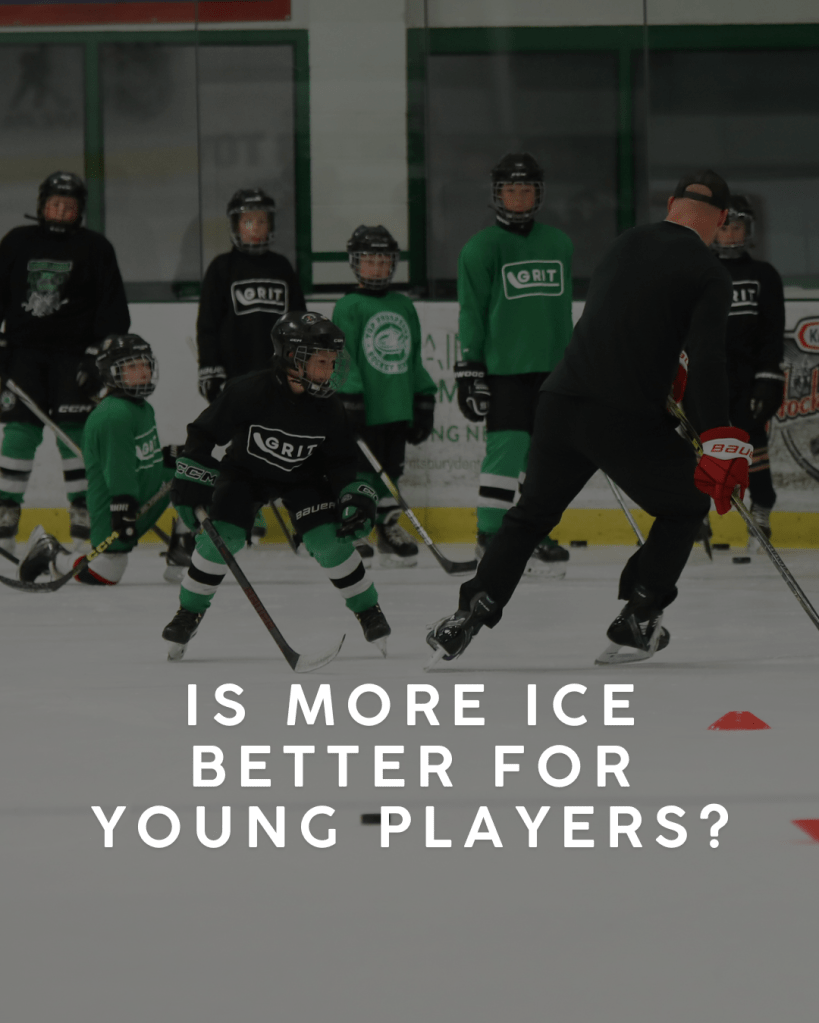
When we set out to build GRIT Academy, we asked ourselves a critical question: What do youth hockey players actually need that they aren’t getting from their regular teams?
Parents often want more reps, more conditioning, and higher intensity. We’ve all seen the standard power skating sessions: lines of players skating hard up and down the ice, gasping for air by the end. While conditioning has its place, treating every skill session like a track meet is actually holding players back from reaching elite levels.
Our Academy philosophy is different. We purposely slow things down to focus on highly technical, biomechanical teaching. Because our student-athletes are on the ice every single day, our “laboratory approach” is designed to build elite habits without burning them out. Here is why this methodology is the ultimate competitive advantage for your child:
1. Building “Perfect” Muscle Memory
Motor skill acquisition relies on a neural process called myelination—the reinforcing of pathways in the brain that make movements automatic. Myelin doesn’t know the difference between a good habit and a bad one; it only reinforces what is repeated. If a player does 50 high-speed repetitions of a crossover with poor hip alignment, they are simply mastering a bad habit. By slowing down, we isolate the exact mechanics—ankle flexion, weight transfer, and edge control—ensuring they encode flawless muscle memory.
2. The Modern Game Demands Agility, Not Just Straight-Line Speed
Traditional power skating focuses almost entirely on the classic, linear North-South stride. But the modern game is played East-West. Today’s elite players rely on deception, tight-area escapes, punch turns, and linear crossovers. These hyper-technical micro-movements cannot be learned at full speed. We break these movements down to a molecular level so players can manipulate space and become truly evasive on the ice.
3. Managing the Daily Grind (Avoiding System Overload)
With a daily academy schedule on top of weekend club games, physical and mental fatigue is the biggest threat to a young player’s development. High-repetition “grinder” sessions overload the central nervous system and increase the risk of overuse injuries. Our technical sessions challenge players cognitively rather than just physically. They leave the ice sharper, smarter, and physically fresh enough to excel in their weekend games.


Leave a Reply