
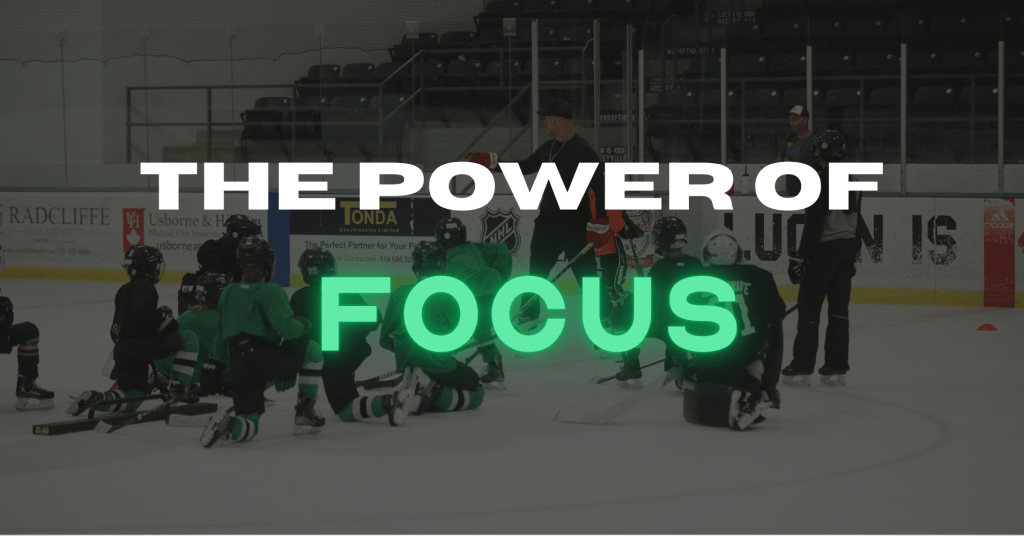
The Power of Focus: A Game-Changer for Young Athletes
In youth hockey, skills and ability steal the spotlight. Some players are “naturals” at a young age while others take longer to find their game. But at some point, the kids who find a way to learn and develop begin to outpace their peers. What separates highly skilled young players from those who don’t quite seem to reach their potential?
The Answer: Focus
Skill games like hockey demand more than athletic ability; success requires discipline, sense, and resilience. A focused athlete can tune out distractions, execute plays effectively, and adapt to challenges with confidence. Here’s why focus is so essential:
1. Enhances Skill Development
Young athletes improve when they can dedicate full attention to learning and refining their skills. In my experience, young players who outpace their teammates are (coincidentally) the most focused and attentive kids on the ice. I have rarely (if ever) seen the kid who’s always goofing off and distracting others in the drill become a standout player.
2. Boosts Game-Time Performance
Hockey is a chaotic game. It’s fast, it’s congested, and quick decision-making is critical for strong play. The most successful young players aren’t staring into the stands, worried about what dad thinks, or skating around the ice in constant hesitation and fear over making a mistake. An athlete who can focus on the game and let their play naturally unfold leads to smarter decisions, better execution, and improved reaction time on the ice.
3. Builds Stronger Work Ethic
The ability to focus extends beyond the ice. Athletes who can concentrate during practice develop stronger habits that contribute to consistent improvement and long-term success when off the ice. If learning can be accelerated anywhere you go, you’ll improve faster with fewer resources. In a game like hockey where development is often expensive and difficult to access, the skill of focus and work ethic become critical for success.
How to Improve Concentration
While some young athletes naturally have a high level of focus, it’s a skill that can be trained and improved. Here are a few strategies to help athletes sharpen their concentration:
- Set Clear Goals with Your Player – Having specific, achievable goals gives athletes a purpose and keeps them engaged in their development. Even athletes as young as 7-8 years old can write down a clear goal and what they would need to improve to reach that goal. Here’s an example: Clear Goal- Make AAA next season. What to improve- I need a harder shot and better puck handling. What I need to do- 10 minutes of shooting in the basement and 4 puck-handling drills each day. Let your player decide for themselves what their goals are, where to improve, and how to get there.
- Limit Parent Distractions – Whether in practice or competition, minimizing external distractions helps athletes stay locked in. Parents who are constantly in their child’s ear and getting in the way of the coaches are one of the primary sources of distraction and hesitation in young players. It’s OK to give your young player helpful pointers, but too much hockey talk before games, in the dressing room, or the car ride home often comes off as criticism. A player who has to worry about what mom and dad think every shift is not a focused player.
- Limit Electronic Distractions – Smartphones, Television, and handheld devices may seem like a way to increase focus, but with the endless switching of content and the ability to access any show, clip, or game at will, kids are losing the ability to concentrate at younger ages. I’m not saying your child can’t watch a show or play a video game if they want to be good athletes, but if devices are taking the place of parent interactions or if your child is never forced to just be bored for some time each day, they will develop a scattered mind.
- Positive Talk Only– Before players get to early adulthood, a parent’s job should be to support, encourage, and motivate their athletes. That doesn’t mean we don’t hold kids accountable or teach them life lessons, but if a young player has to hear about what they need to improve on after every single session, what they’ll eventually hear is “I’m not good enough for this”. Confident kids get into the corners, attack the puck, take chances, and try again. Kids who are overwhelmed with criticism would rather play small and avoid mistakes than rise to their potential.
- Develop Routines – Pre-game routines help create consistency and trigger a focused mindset. The more chaos a kid has before game time, the harder it’s going to be to focus. When possible, consider things like at-home warm-up routines, pre-game meals, consistency with arena arrival times, and even pump-up songs on the way to the game.
Physical ability is one piece of the puzzle. The ability to focus—whether in practice, during competition, or in recovery—sets the best apart. By training their minds as well as their bodies, young athletes can maximize their potential, elevate their performance, and set themselves up for long-term success. Developing focus isn’t just about sports—it’s a life skill that will benefit them in every endeavor they pursue, and that’s what youth sports should be about.
 GRIT Hockey
Leave a comment